

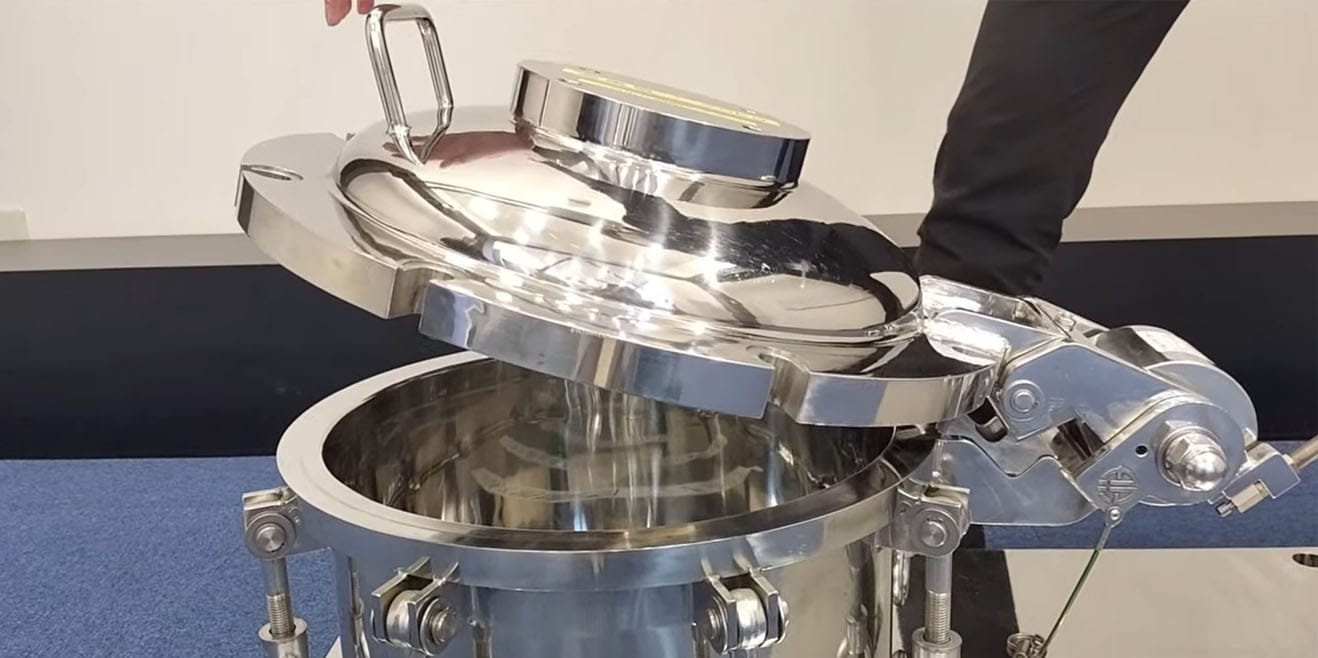
Facilities operating tanks, reaction vessels, and pressure vessels routinely require workers to lift and lower heavy covers multiple times per shift. Each lift cycle creates biomechanical stress that can eventually lead to repetitive motion injuries.
Implementing spring-assisted lid lifting can improve how your facility manages these risks. Spring-assisted methods fundamentally differ from manual ones in how they distribute physical load.
What Are Spring-Assisted Lid Lifting and Manual Lid Lifting?
Spring-assisted lid lifting uses the force contained within a spring to open and close heavy covers, making them feel lighter and easier to handle. The spring will expand when you open the cover, and its stored energy will work in your favor, allowing for one-handed operation. Spring-assisted systems can accommodate lids weighing between roughly 13 and 293 pounds, depending on the model.
Manual lid lifting doesn’t use mechanical assistance, instead relying on the operator’s innate strength. Several variables affect the level of risk involved:
- The lid weight determines the baseline force requirement for each lift.
- The lifting frequency compounds that force across multiple cycles per shift.
- The operator’s posture influences which muscle groups bear the load and how efficiently force transfers through their body.
Manual systems lack controlled-motion features, so the operator must manage the lifting and lowering phases without mechanical assistance.
How Do Spring-Assisted and Manual Lid Lifting Differ?
Review this chart for a visual comparison of the two lifting techniques.
| Feature | Manual Lid Lifting | Spring-Assisted Lid Lifting |
| Effort required | The operator must provide 100% of the force to lift, hold, and lower the lid. | The operator provides only a fraction of the force. The spring mechanism does most of the work. |
| Safety | Higher risk of injury. A heavy lid can slip and slam shut, potentially causing pinched fingers. | Much safer. The spring reduces the chance of the lid slamming shut. Many systems also lock the lid in the open position. |
| Convenience | Can be cumbersome. Often requires two hands — one to lift the lid and another to hold it open or place a prop. | Highly convenient. Allows for easy, one-handed operation and frees up both hands for work once the lid is secured in the open position. |
| Control | The operator has direct control but must constantly apply force to keep the lid from falling. | The mechanism controls the lid’s movement. |
| Application | Best suited for lightweight lids where the operator’s strength is sufficient. | Ideal for heavy or large lids that would be unsafe to lift manually. |
| Mechanism | Simple hinge. | A more complex system of springs, stays, and hinges designed for the lid’s weight. |
The Risks of Manual Lid Lifting
Manual lid lifting results in distinct and well-documented injury patterns.
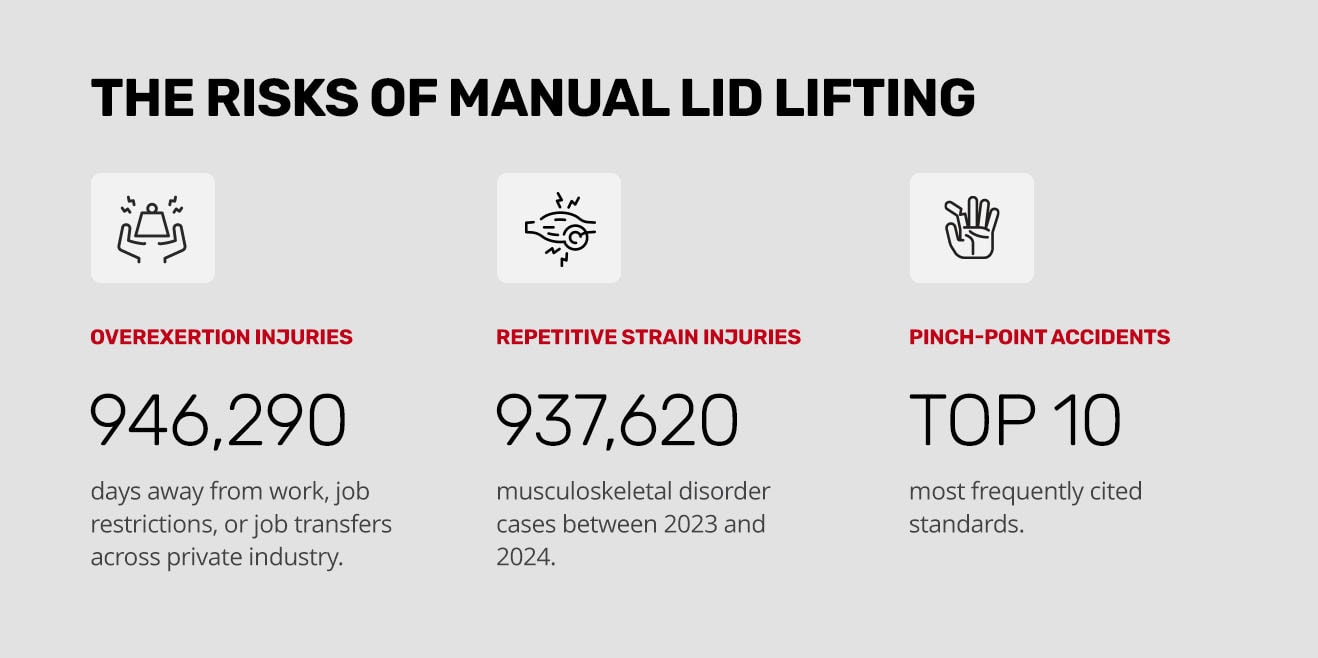
- Overexertion injuries: Overexertion is a leading cause of workplace injuries, according to the Bureau of Labor Statistics. Repetitive motion and bodily conditions caused 946,290 days away from work, job restrictions, or job transfers across private industry.
- Repetitive strain injuries: Repeated manual lid lifting can lead to back strain, shoulder injuries, and upper extremity disorders. The Occupational Safety and Health Administration classifies these conditions as musculoskeletal disorders, or MSDs. The private sector experienced 937,620 musculoskeletal disorder cases requiring days away from work, job restrictions, or job transfers between 2023 and 2024.
- Pinch-point accidents: Manual lowering of heavy lids creates pinch-point hazards because it provides no inherent protection against unexpected or uncontrolled lid closure. An operator’s hands, fingers, and arms can get caught and crushed. OSHA’s machine guarding standard addresses pinch-point hazards, but violations rank among the top 10 most frequently cited standards.
How Spring-Assisted Lid Lifting Reduces These Risks
Spring-assisted lid lifting counters the three injury categories described above. The spring mechanism dramatically reduces the physical load per lift cycle, decreasing overexertion and repetitive strain injuries. Instead of generating and sustaining high forces to overcome the cover’s weight, the operator guides a counterbalanced system through its range of motion. The drop in cumulative musculoskeletal stress reduces the likelihood of tissue damage from repeated exposures.
For pinch-point hazards, controlled motion ensures lids close more predictably thus reducing the hazard level.
Spring-assisted systems are proactive engineering controls that align with OSHA’s General Duty Clause under Section 5(a)(1). This clause requires employers to address recognized hazards likely to cause serious physical harm. By eliminating the need for high-force exertion and providing controlled lid motion, spring-assisted lifting addresses ergonomic and machine-guarding concerns that OSHA identifies as hazards in industrial facilities.
Is Spring-Assisted Lid Lifting Right for Your Facility?
If you manage operations or safety at a facility with tank or vessel access requirements, asking the following four questions can help you assess whether your current approach creates avoidable risk.
Spring-assisted lid lifting is worth exploring further if two or more of these conditions exist at your facility.
- How heavy are your covers? Heavier closures generate greater force requirements per lift. If your operators struggle to open or close covers smoothly or need two hands to control descent, weight is already causing strain that will add up over hundreds of lift cycles.
- How often do operators access these vessels? According to the National Safety Council, fatigue contributes to 13% of workplace injuries. Infrequent lifts distribute exposure across longer periods. High-frequency access during production runs concentrates that exposure into shorter windows, during which fatigue reduces operator capacity.
- What does your safety record show? Review your incident logs for injuries and complaints tied to vessel access. A single recordable injury connected to lid operations demonstrates that manual methods have caused harm. Near-miss reports and operator comments about cover weight provide early indicators of potential injuries.
- Where does your facility stand on ergonomic compliance? If you’re preparing for an OSHA inspection or running an active safety improvement program, uncontrolled manual lifting can be a gap that may lead to scrutiny during audits. OSHA can cite facilities under the General Duty Clause when recognized ergonomic hazards remain unaddressed, and those citations can carry financial and reputational impact.
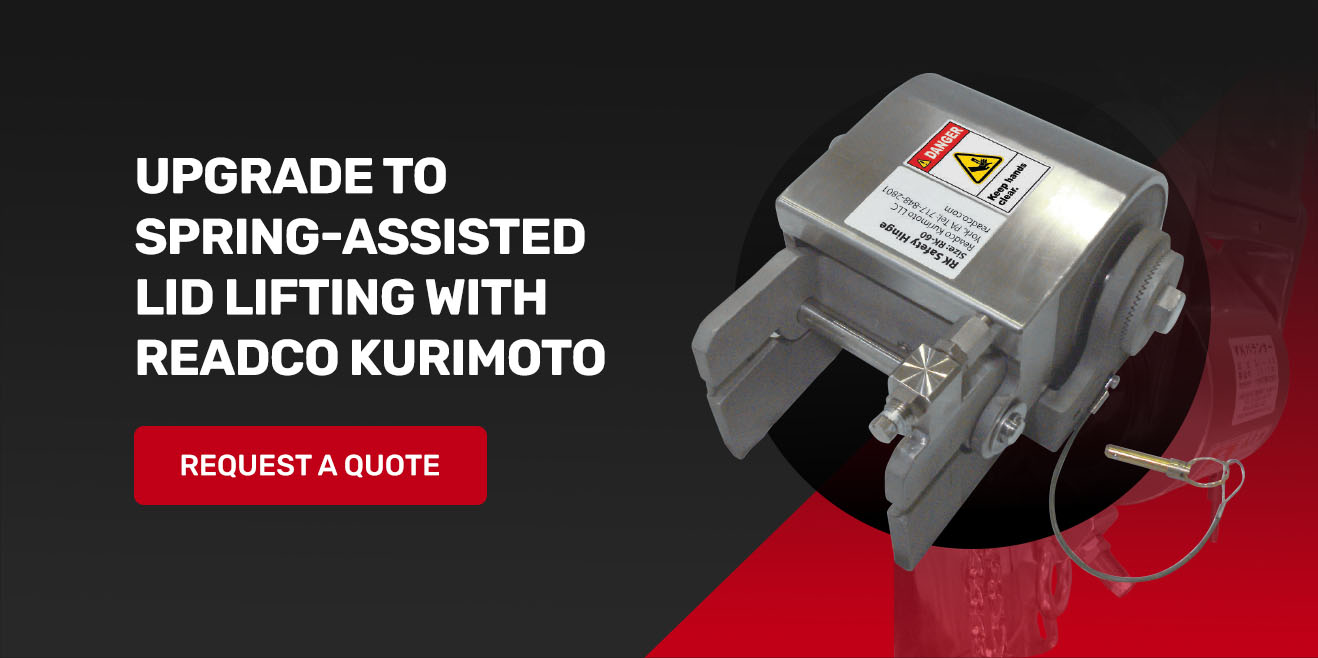
Upgrade to Spring-Assisted Lid Lifting With Readco Kurimoto
We engineered the RK Safety Hinge as a purpose-built solution for industrial tanks, reaction vessels, and pressure vessels. It reduces lift force by up to 80%, operates without external power, and includes an integrated safety pin to securely hold lids open.
Reach out to us to request a quote and discuss how we can help your facility reduce injury risk.