

Increasing Sauce Production with Industrial Food Mixers
Increasing Sauce Production with Industrial Food Mixers
The sauce and condiment manufacturing industry continues its steady growth, with the global market projected to expand from $4.1 billion in 2025 to $6.047 billion by 2035. As producers scale operations to meet this demand, they face fundamental challenges in maintaining consistent product quality at higher production volumes.
Traditional batch mixing processes may work effectively at smaller scales, but they often struggle to deliver the same performance when production requirements increase. The physics of mixing in larger vessels creates different shear patterns, temperature distributions, and residence times that can affect emulsion stability, particle dispersion, and overall product consistency.
Scale-Up Challenges in Traditional Batch Processing
Batch mixing physics are straightforward at small volumes. An impeller in a reasonably sized vessel can distribute shear energy across the full product with decent uniformity. But as the diameter grows, mixing energy dissipates before reaching the periphery, creating aggressive shear near the blades and stagnant zones everywhere else.
With emulsion-based products like mayonnaise, vinaigrettes, or cream sauces, industrial mixers directly influence sauce consistency. Any uneven distribution leads directly to quality failures. Some portions of the batch get over-processed while others never reach the target droplet size for a stable emulsion. Product gets reworked or scrapped, and the waste adds up fast.
The operational complexity increases proportionally with scale. Batch processing requires discrete loading, mixing, holding, sampling, and discharge steps for each cycle. Capacity expansion demands parallel tank installations, multiplying space, utility, and labor requirements. Inherent batch-to-batch shear variation requires continuous quality control and corrective measures.
Eventually, batch capacity simply stops delivering usable output.
How Continuous Food Processing Equipment Changes the Equation
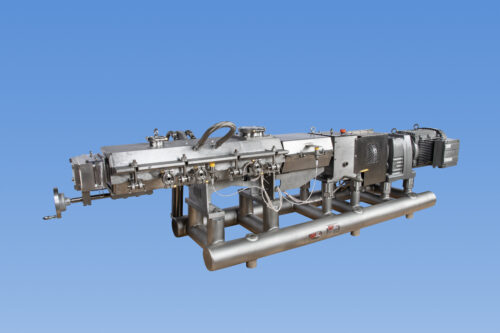
Continuous Processors (CP) take a fundamentally different approach. Rather than filling a large vessel and mixing its contents all at once, the CP meters raw ingredients into a compact mixing chamber through calibrated loss-in-weight feeders and pumps. Twin co-rotating shafts advance the material through configurable mixing zones, with indirect heating or cooling through the barrel jacket, maintaining precise temperature control at every stage.
The continuous process delivers remarkable consistency for high-volume sauce manufacturing. Every particle encounters the same mixing intensity, processing time, and temperature profile throughout the system. This uniformity ensures that product quality remains identical from the first gallon through thousands of gallons of production, improving food production line efficiency. Continuous processing maintains production consistency, whether running short campaigns or extended 24-hour operations.
Configurable Shear for Complex Sauce Formulations
Many sauces demand opposite things from the same mixing process. A vinaigrette base needs aggressive shear to form a stable oil-in-water emulsion, but a chunky salsa needs gentle handling to preserve diced tomatoes and peppers. In a batch tank, you compromise on one or both.
Commercial sauce mixing technology that uses CP handles this through zone-by-zone element configuration. High-shear sections handle emulsification, dispersion, and particle size reduction. Low-shear sections downstream fold in delicate particulates without mechanical damage. Switching formulations means reconfiguring the element layout, not purchasing new equipment. If your sauce has a fragile ingredient this ingredient can be added part way down the barrel allowing less exposure to the mixing elements this minimizing damage.
The CP processes viscous sauces and thin dressings with equal precision by adjusting element geometry and feed rates.
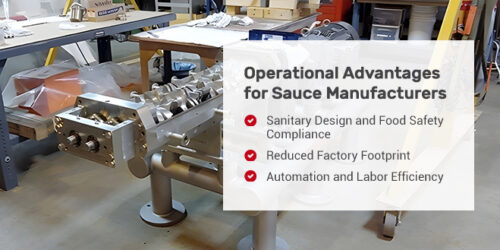
Operational Advantages for Sauce Manufacturers
The benefits of continuous processing include:
Sanitary Design and Food Safety Compliance
Our CP operates as a fully enclosed system that keeps the product sealed from the surrounding environment throughout the mixing process. For sauce manufacturers, the practical benefits include:
- A closed barrel that eliminates exposure to airborne contaminants, dust, and pests during production.
- Smooth, fully drainable product contact surfaces that support effective CIP and manual inspection.
- Solid, one-piece rotating shafts that will not harbor residual material, with removable end plates and Tri-Clover connections for fast disassembly by a single operator.
- Built-in traceability support when paired with a process control system, allowing each input to be monitored and documented throughout the run.
Equipment is available in configurations meeting USDA, FDA, and 3-A dairy and food sanitary standards. For shelf-stable and chilled sauces where hygienic design determines product viability, this sealed architecture offers a meaningful step up from open-top batch vessels.
Reduced Factory Footprint
A single continuous processor can match or exceed the output of multiple batch tanks while occupying a compact footprint. For manufacturers already pressed for room, the space implications are significant:
- Eliminating surplus tanks, staging vessels, and transfer equipment frees floor space for packaging, warehousing, or future process additions.
- A simplified plant layout reduces intermediate storage and transfer points.
- Fewer CIP circuits are needed compared with multi-tank batch installations.
For plants constrained by existing building geometry, the ability to increase capacity without constructing a new tank farm is a tangible advantage.
Automation and Labor Efficiency
Our CP is designed to operate with loss-in-weight feeders and pumps, with all ingredient flows and processor parameters coordinated through a process control system. For high-volume sauce lines, this means:
- Lower direct labor per pound of sauce, because loading, mixing, and discharge are continuous and recipe-driven.
- Reduced human error, as ingredient ratios and residence time are controlled automatically rather than measured manually.
- Real-time monitoring of torque, temperature, and flow for tighter process control and full traceability.
On high-volume lines, this shift from operator-driven batch control to automated continuous control is often the largest single contributor to cost-per-unit reduction.
Validate Your Recipe Before You Invest
Moving from batch to continuous is a significant process change, and we believe the best way to build confidence in that decision is with real data from real equipment.
We operate a fully equipped test laboratory in York, PA, with 1-inch, 2-inch, and 5-inch continuous processors, along with feeders, pumps, and temperature control equipment configured to replicate production conditions. Our lab technicians work alongside your engineering team to adjust shear, residence time, temperature, and feed rates until the formulation performs to specification.
Testing programs typically complete within one to three days, depending on formulation complexity and target parameters. Each trial generates comprehensive documentation, including process conditions, performance data, and product samples for thorough evaluation. This systematic approach provides the technical foundation needed for confident scale-up decisions.
Beyond initial trials, the testing program serves as a validation platform for new formulations, process optimization studies, and troubleshooting existing production challenges. This ongoing technical support helps manufacturers maximize their continuous processing investment while minimizing implementation risks.
Scale Your Sauce Line with Confidence
Readco Kurimoto has been engineering industrial food mixers for over a century, with deep experience across food, confectionery, chemical, and pharmaceutical processing. Every continuous processor is custom-designed to the application, manufactured to ASME and ASTM standards, and built in the United States.
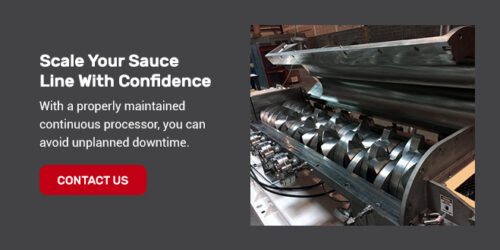
These machines are made to last. With a properly maintained continuous processor, you can avoid unplanned downtime. If you’re interested in seeing what continuous processing can do for your sauce line, contact us to schedule a lab trial and put your formulation through the process firsthand.
How Continuous Processors Can Improve Battery Performance
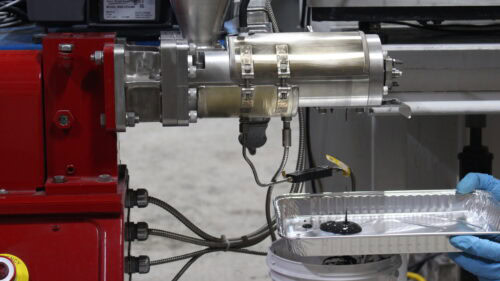
Creating batteries requires reacting and mixing materials. Although batch mixing is capable of kneading high-viscosity materials used for the electrodes and electrolytes of most batteries, continuous mixing processors offer many advantages that can help your business.
How Continuous Mixer Processors Improve Battery Performance
The end product is only as good as the raw materials and the fabrication processes used. When compared with batch mixing, continuous mixing has been found to offer more uniform dispersion. With batteries, more uniform material dispersion results in efficient, dense electrodes. Better electrodes offer a range of benefits, including:
- Better electron transport: With continuous mixers, carbon black and other conductive additives are better dispersed because these mixers are more precise and twin-screw mixing prevents over-shear, resulting in a homogeneous paste with fewer voids. This improves battery performance and capacity by increasing electrical conductivity.
- Reduced internal resistance: More efficient electrodes mean better conductivity, with less overheating and power loss.
- Higher energy density: In addition to creating more efficient electrodes, continuous processes can handle materials with higher viscosity than batch mixers. The higher solids loading in the slurry often results in higher energy density.
- Longer life cycle: With uniform dispersion of active materials, fewer materials cluster, improving the battery lifespan by reducing mechanical degradation.
- Improved safety: With stronger and denser electrodes, your batteries may have higher mechanical strength, reducing charging damage and improving the reliability of batteries.
- Enhanced electrode properties: Dry processes allow for even distribution of binders and conductive additives, enhancing electrodes’ mechanical properties. A batch mixer sometimes breaks down binders, which can affect the adhesion of conductive agents and active materials. Continuous mixers are gentler, reducing delamination by ensuring particle adhesion.
Another benefit of continuous mixers is that they can help in creating a bubble-free and uniform electrode coating, which enables you to develop batteries with efficient electron paths and reliable battery storage. This, in turn, creates more dependable batteries and faster, more reliable charging without cracking.
Better Batteries With Process Benefits
Mixing methods can affect the energy density and other advantages of solid-state batteries (SSBs), but creating a better battery also means developing a production process that reduces flaws and delivers cost savings you can pass on to customers. Here is how continuous mixing processors can help you improve your process and produce better batteries of all types:
- Reduce defects: Continuous mixers achieve an even distribution of materials by breaking down agglomerates more efficiently than batch mixers. They also reduce the errors that can occur with manual loading. As a result, your electrodes and coatings are more consistent, improving battery capacity and reducing failures.
- Produce more batteries: Batch mixers have built-in downtime during loading and unloading, but continuous mixers enable high-volume, continuous production, helping you meet customer demand.
- Reduce the risk of contamination: Contamination and impurities can pose safety risks, such as lithium-ion battery fires. Since continuous processes are closed, there is less of a risk of contamination. An enclosed system can also reduce the risk of moisture entering the mix, thereby reducing oxidation and air entrapment.
- Lower energy use and costs: Continuous mixers require less solvent than batch mixers, helping reduce energy use during drying. In addition, with precise mixing chambers and fewer shutdowns, continuous mixers can save on energy costs when compared with batch mixers, especially at high production volumes.
- Improve oversight and cut waste: You can maintain strict quality control and make real-time adjustments as needed to temperature, shaft speed, residence time, shear, and viscosity. Smaller mixing chambers, compared with batch mixers, allow you to minimize waste if a problem arises.
Why Choose Readco Kurimoto for Battery Industrial Mixing Equipment?
At Readco Kurimoto, our team can customize mixing solutions for even the most advanced batteries. Top original equipment manufacturers (OEMs) already work with us, and we can make sure your mixer processors integrate with existing or automated equipment. Our continuous mixers can help at many stages of battery production for lithium-ion batteries, hydrogen fuel cells, solid-state batteries, and more.
We have decades of experience in the battery sector, helping enhance product safety, improve efficiency and productivity, and create more reliable products. We have developed lithium-ion battery paste mixing solutions, dry blending and solid-state battery powder solutions, and other applications. Our mixer processors can mix, shear, and blend with very low moisture content, and we have extensive experience in high-stakes industries with no margin for error.
As the sector shifts, working with Readco Kurimoto means you have a partner who can help your production lines stay efficient today and continue to scale for customers tomorrow.
Contact Us
Our process development laboratory is here to collaborate with you to develop solutions for your specific needs. When you work with us, you receive a comprehensive report and proof of concept, so you know the process will work in your plant.
Contact our team today to learn more about our capabilities and to review your needs.
Safe and Efficient Mixing of Hazardous Chemicals
The most effective way to protect personnel is to contain these vapors and ultimately eliminate their interactions with the product. That’s where continuous processing comes in. Transitioning from open batch tanks to closed-loop continuous systems can help manufacturers improve safety while maintaining product consistency.
In this article, we’ll discuss how to eliminate risks inherent in open batch processing and achieve compliance through containment. You’ll learn how to safely process high-viscosity and volatile materials — without sacrificing speed.
Safety Challenges with Traditional Batch Methods
The traditional batch method can present many chemical mixing safety risks with its manual exposure points and open-loop flaws:
- Manual exposure points: In many facilities, operators must manually add bags of powder or pour liquids into a mixing tank. This moment of transfer is the riskiest point in the entire production line. Even with local exhaust ventilation, the operator is physically close to the hazard. Dust clouds from hazardous solids can form explosive atmospheres, while volatile organic compounds (VOCs) can escape into the breathing zone, putting personnel at risk.
- Inconsistent reaction control: Reaction control is another challenge. Large batch tanks often struggle with heat transfer. The material near the walls stays cool, while the material in the center can create a hot spot. In exothermic reactions, these hot spots can lead to runaway reactions. Due to the large volume of material in batch tanks, if a reaction were to accelerate out of control, there’s a higher risk of a major containment event — one involving thousands of pounds of chemical product.
- The open-loop flaw: The open-loop nature of batch processing makes maintenance much more difficult. Batch mixers often need to be cleaned between runs to prevent cross-contamination. This cleaning process usually requires operators to manually scrape the walls or use high-pressure washing to clean them, again exposing them to chemical residues. This cycle of constantly opening, filling, mixing, emptying, and cleaning can increase the likelihood of an incident.
Safety Advantages of Continuous Processing
With its fully enclosed system, continuous processing fundamentally changes the safety profile of chemical manufacturing. Here are the main safety benefits of continuous processors:
Closed-Loop Containment
A continuous processor works by feeding ingredients into the system at a steady monitored rate. From there, the ingredients are processed and discharged from the mix chamber. This containment engineering is the most effective way to adhere to the hierarchy of controls. It prioritizes hazard elimination instead of relying solely on personal protective equipment (PPE). From feed to discharge, the closed mix chamber limits vapor from escaping, helping protect personnel from the risk of exposure.
Small Process Inventory
One of the most critical safety features of a continuous processor is its small process inventory. While a batch tank could hold thousands of gallons of reactive material at once, a continuous processor work with just a few gallons at a time, and has a much shorter residence time, often less than a minute.
This means, at any given second, there are only a few pounds of material inside the mixer. If a power failure or reaction anomaly occurs, the risk is limited to that small amount of material. Reducing that active inventory can turn a potential safety event into a manageable maintenance task.
Minimizing Oxygen Interaction
Continuous processors can be easily blanketed with nitrogen or another inert gas. This can drastically reduce the risk of fire and explosions when working with flammable solvents. It makes maintaining an inert atmosphere more efficient and reliable, as the free volume inside the mixer is small. By displacing oxygen, the system keeps flammable vapors from finding an ignition source, safely processing solvents and combustible dusts that would be otherwise dangerous in an open tank.
Achieving Compliance with Continuous Processing
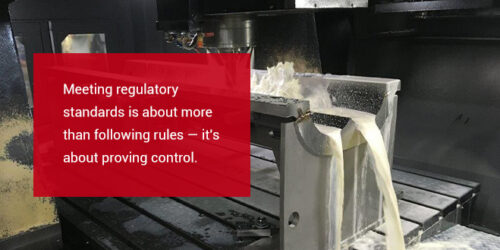
Meeting regulatory standards is about more than following rules — it’s about proving control. The National Fire Protection Association (NFPA) sets the standards for handling hazardous materials, and a continuous processor makes meeting compliance much easier.
NFPA 400 specifically addresses the maximum allowable quantity (MAQ) of hazardous materials allowed in a control area. Since continuous processors hold a small volume of material, they can help your facility stay well below the MAQ thresholds. This can make it easier to follow building code requirements while reducing the need for expensive fire suppression upgrades.
Documentation is also crucial to meet NFPA standards, and automated continuous systems make it easy by logging data for every second of production. They record temperature, pressure, motor load, and feed rates all in real time. If there’s an OSHA audit or quality control inquiry, you have a traceable digital trail to prove your process stayed within safe operating limits. This can be difficult to achieve with manual batch records.
Handling High Viscosity Materials
There’s a common misconception that continuous processors cannot handle thick or sticky materials. Yet, these systems are specifically engineered for high-viscosity applications that would otherwise stall a standard mixer. Readco Kurimoto’s equipment has a twin-shaft design, providing the right amount of torque to mix materials with the consistency of sealants or solid propellants.
The self-wiping geometry of the shafts is a critical safety feature for these materials. As the paddles intermesh, they continuously wipe the material from the partner shaft and barrel walls. This prevents product buildup, a common cause of overheating in sticky chemical mixes. By keeping the material moving and renewing the surface area, the processor ensures uniform heat transfer and prevents dangerous hot spots from forming.
Customizing Equipment for Chemical Compatibility
The safety of a chemical process largely depends on the materials of construction. Standard stainless steel is often insufficient for most corrosive or abrasive hazardous chemicals. If the equipment walls corrode, the containment is immediately breached. That’s why Readco Kurimoto engineers every machine with the specific chemical compatibility of the application in mind.
Advanced metallurgy options include Hastelloy®, Alloy 20 stainless steel, ceramics, and tungsten carbide. This ensures the physical integrity of the mixer remains intact throughout its years of service.
The integrity of the closed system also relies on the seals. Chemical-resistant seal materials can provide containment inside the barrel. These seals are designed to withstand the aggressiveness of the chemicals being processed, preventing leaks that could compromise operator safety.
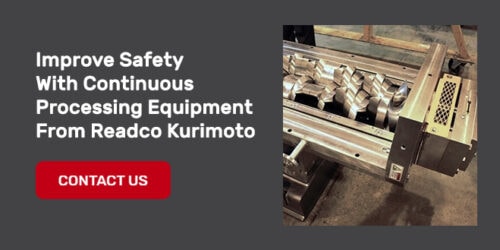
Improve Safety with Continuous Processing Equipment from Readco Kurimoto
The era of using manual batch mixing for hazardous chemicals is coming to a close. The risks from open hatches, manual transfers, and large reaction volumes have made continuous processing the safer approach. It offers a solution where safety is engineered into the machine itself, not just added as a procedure.
Readco Kurimoto can help you transition to this safer, more efficient model. Built in the USA, our custom-engineered processors can help improve your safety in hazardous material handling. From reducing process inventory to helping you meet NFPA compliance, this advanced technology can help you keep up with modern safety demands. Our equipment also meets stringent ASME and ASTM standards.
Do not compromise on safety or efficiency. Contact us today to learn more about the continuous processor and how it can improve hazardous material handling.