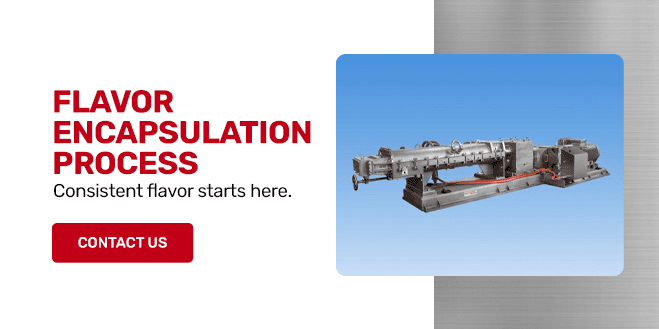


Continuous processors improve flavor encapsulation by providing unparalleled control over the manufacturing process, resulting in a more consistently and efficiently produced final product. Learn more about the specific mechanisms through which these systems deliver superior results.
Understanding Flavor Encapsulation and Continuous Processing
Flavor encapsulation coats volatile flavor compounds to shield them from environmental factors that can affect aroma and taste. This protective barrier is crucial for preserving flavor integrity, extending shelf life, and controlling release during use. This ensures consistent sensory experiences across applications in the food, confectionery, pharmaceutical, and nutraceutical industries.
To achieve such precise protection and controlled release, the encapsulation process itself must be highly consistent. This is where continuous processing becomes paramount. At its core, continuous processing involves a steady flow of materials through a system, with each step occurring sequentially and without pauses.
This fundamentally contrasts with batch processing, where distinct quantities of material are processed in separate operations, often leading to variability. For flavor encapsulation, continuous processing significantly improves outcomes by maintaining consistent processing parameters throughout the production.
How Do Continuous Processors Impact Flavor?
There are several reasons continuous processing systems consistently outperform batch systems when it comes to flavor encapsulation:
Consistency Through Steady-State Operation
In batch processes, the initial and final phases often differ significantly from the main processing phase. Continuous systems, once stabilized, operate at a steady state. Parameters like temperature, pressure, flow rate, and residence time are maintained precisely and consistently throughout the run.
This steady-state operation ensures that every particle or droplet of flavor passing through the system experiences virtually identical processing conditions. The result is an encapsulate with consistent wall thickness and flavor loading that minimizes variations in flavor release profiles, stability, and overall quality.
Precise and Independent Process Control
The multiple operations, such as mixing, heating, emulsification, cooling, and drying, in continuous processing can be independently controlled and optimized without significantly impacting the others. For instance, the emulsification intensity can be fine-tuned without affecting the subsequent drying temperature.
Modern continuous processors incorporate advanced sensors and automated control systems. These systems continuously monitor critical parameters and make real-time adjustments to maintain optimal conditions. They are far more responsive and precise than manual adjustments in a batch system, preventing excursions that could damage flavors.
Continuous systems also enable highly precise application of mechanical energy for mixing or thermal energy for melting and drying. Applying just enough energy achieves the desired effect without overstressing or degrading the flavor, which is often sensitive to excessive heat.
Enhanced Mass and Heat Transfer Efficiency
For mass transfer, continuous systems ensure the flavor is finely and homogeneously dispersed within the encapsulating material. This uniform distribution directly maximizes the interfacial area for interaction, thus ensuring complete and effective encapsulation. Methods like continuous emulsification or melt mixing within a continuous processor achieve this very effectively.
For heat transfer, continuous drying processes rely on the steady material flow to provide precise, dynamic control over air temperature, humidity, and flow rates. This optimized thermal management enables highly efficient solvent removal while minimizing flavor loss through volatilization by rapidly forming a protective shell.

Reduced Exposure to Degradative Factors
In continuous flow, the residence time of materials in each processing zone can be tightly controlled. This means that flavor components are exposed to potentially harsh conditions for the shortest possible duration, and with consistent timing, preserving sensitive flavors. A Continuous Processor trades time for intensity and greatly reduces heat history of the final product.
Additionally, continuous-flow designs inherently minimize dead zones or stagnant areas where material can accumulate and degrade. It minimizes potential for microbial growth or product fouling, which could compromise flavor integrity.
Moreover, many continuous systems can be operated in sealed environments and effectively exclude oxygen. This is paramount for protecting flavors that are highly susceptible to oxidation, such as those in citrus oils, natural vanilla extracts, and nut-based flavors.
Examples of Continuous Processors and Their Encapsulation Benefits
Understanding these options helps you select the optimal system for your specific formulation requirements.
- Continuous extrusion: A continuous flow of encapsulant and flavor is fed into a single or twin-screw extruder. The material is conveyed, mixed, heated, melted, and then forced through a die to form a continuous strand. This approach provides precise temperature zoning to protect sensitive flavors and enables rapid solidification to lock in flavor.
- Twin screw continuous processing: A twin-screw continuous processor provides a continuous flow of encapsulant and flavor through a pair of co-rotating shafts with precisely tuned mixing element configurations. The twin-screw continuous processor is able to mix, heat, and melt the materials with a short residence time since it can focus on mixing intensity without the need for building high pressure. Once melted and mixed the product discharges into a simplified extruding system to make the shape, saving floor space, cost, and energy usage compared to large compounding extruders.
- Continuous spray drying: A liquid feed containing the flavor and encapsulating coating is atomized into fine droplets within a chamber, where hot air rapidly evaporates the water and leaves encapsulated powder particles. Additionally, advanced continuous spray dryers can be optimized with lower inlet temperatures or specialized nozzles to reduce flavor loss.
- Continuous fluidized bed coating: Solid flavor particles or agglomerates are suspended in an upward-moving stream of air. A continuous spray of encapsulating liquid is applied to the particles, which then dry and form a coating layer by layer. This provides a highly uniform coating thickness.
- Continuous co-extrusion and emulsification systems: In some systems, a continuous flow of a liquid flavor is extruded with an outer encapsulating shell to form microcapsules that are then cut or solidified. Alternatively, modern continuous microfluidic devices can generate flavor-in-oil or flavor-in-water emulsions as precursors for encapsulation. These offer exceptional control over capsule size and structure, leading to very precise release characteristics and high encapsulation efficiency.
The Business Case for Continuous Processing
Continuous systems reduce waste through tighter process control and elimination of batch-to-batch variability:
- Rejected material decreases substantially when every unit of production experiences identical conditions.
- Labor costs decline as automated systems require less hands-on intervention, and the elimination of batch changeover procedures frees personnel for higher-value tasks.
- Higher throughput capacity per square foot of facility space means continuous lines can produce significantly larger volumes without proportional increases in capital or operational expenses.
Continuous processing supports premium product development for:
- Food products: Natural flavor systems in food and confectionery applications, which command higher margins but present greater stability challenges, become commercially viable when protected through precisely controlled encapsulation.
- Pet food: Products with stable, authentic taste profiles, such as those in pet food and pet care, throughout their shelf life differentiate brands in competitive markets, justifying higher price points and building customer loyalty.
- Drug manufacturing: Pharmaceutical and nutraceutical manufacturers similarly benefit from continuous encapsulation when formulating taste-masked active ingredients that improve patient compliance and product marketability.
Optimize Your Flavor Encapsulation Process With Readco Kurimoto
Readco Kurimoto’s continuous processing systems are engineered to meet the demanding requirements of flavor encapsulation across food, confectionery, pharmaceutical, nutraceutical, and specialty chemical applications. Our team brings decades of expertise in continuous mixing technology, including proprietary processing solutions designed for heat-sensitive and volatile compounds.
Before committing to a full-scale system, validate the process in a lab environment through our Process Development Lab Testing services. Our engineers work directly with your formulations to optimize parameters and demonstrate real-world performance. Contact us today to discuss your specific encapsulation needs and explore how continuous processing can deliver the consistency, efficiency, and product quality your operation demands.