

Every rubber product begins with a fundamental decision between natural rubber, synthetic alternatives, or a blend of both. That choice directly impacts mechanical performance, chemical resistance, and manufacturing costs. Yet material selection accounts for only half of the engineering equation. Compounding and mixing determine whether those carefully selected properties actually translate to your finished product.
This guide examines the critical differences between natural and synthetic rubber, compares their respective strengths and limitations, and reveals why the mixing process remains the most overlooked factor in rubber performance.
What Is Natural Rubber?
Natural rubber derives from the latex of Hevea brasiliensis trees through a process of tapping, coagulation, and refinement, producing one of the world’s most versatile elastomers. As a polymer of isoprene, natural rubber delivers exceptional mechanical properties that synthetic alternatives struggle to match.
Key properties:
- High tensile strength and tear resistance.
- Excellent memory elasticity that lets it stretch and return to its original shape.
- Natural tackiness that bonds well to metals and textiles.
- Strong fatigue resistance under repeated flexing.
- Good flexibility at low temperatures.
These characteristics make natural rubber the preferred choice for demanding applications, including tires, shock mounts, conveyor belts, vibration dampeners, and critical industrial seals.
However, natural rubber’s limitations become apparent in harsh environments. Exposure to ozone, UV radiation, oils, and aggressive chemicals causes rapid degradation, while sustained high temperatures break down its molecular structure. These environmental sensitivities restrict natural rubber to applications with controlled operating conditions.
What Is Synthetic Rubber?
Synthetic rubber production involves the controlled polymerization of petroleum-based monomers, allowing engineers to design molecular structures that target specific performance requirements beyond natural rubber’s capabilities. This engineered approach creates elastomers optimized for harsh environments, extreme temperatures, and chemical exposure that would destroy natural rubber.
Common types and uses include the following.
- Styrene-butadiene rubber: Tire treads, conveyor belts, and footwear
- Nitrile rubber: Fuel hoses, gaskets, and seals where oil resistance is critical
- EPDM: Roofing membranes, automotive weatherstripping, and outdoor seals
- Neoprene: Chemical-resistant gloves, wetsuits, and industrial belting
- Silicone: Medical devices, food-grade seals, and high-temperature applications
Synthetic rubber design involves performance trade-offs. Most formulations exhibit lower tensile strength and elasticity than natural rubber, requiring application-specific engineering adjustments. Petroleum-based production also creates pricing volatility tied to oil market fluctuations, contrasting with natural rubber’s more stable agricultural supply chain.
Natural Rubber vs. Synthetic Rubber
| Property | Natural Rubber | Synthetic Rubber |
|---|---|---|
| Tensile strength | High | Moderate |
| Elasticity | Excellent | Good |
| Abrasion resistance | Strong | Strong |
| Chemical resistance | Poor | Good to excellent |
| Temperature range | Limited at extremes | Wide |
| UV/ozone resistance | Poor | Good to excellent |
| Biodegradability | Yes | No |
| Price stability | Fluctuates with crop yield | Fluctuates with oil prices |
Cost varies for both materials based on market factors. Natural rubber prices move with growing conditions, labor availability, and regional crop yields, while synthetic rubber pricing follows petroleum markets. The economics shift with global supply and demand patterns, creating cost advantages at different times.
Sustainability profiles differ between the two materials. Natural rubber biodegrades and comes from renewable trees that produce latex for decades. Synthetic rubber production involves petroleum-based processes, and the material persists in the environment. Manufacturers often evaluate performance requirements and environmental considerations when selecting between these options.
How the Rubber Mixing Process Affects Material Performance
Most natural vs. synthetic rubber comparisons stop at material properties, assuming compounds will perform to specification once you’ve made your selection. The gap between laboratory specifications and production-floor results underscores the criticality of the mixing process.
Rubber compounding combines base polymers with fillers like carbon black or silica, plasticizers, curing agents, and protective additives. Success hinges on distributing these ingredients uniformly throughout the polymer matrix. When dispersion remains incomplete or inconsistent, compounds develop uneven cure profiles, weak spots, and unpredictable performance characteristics.
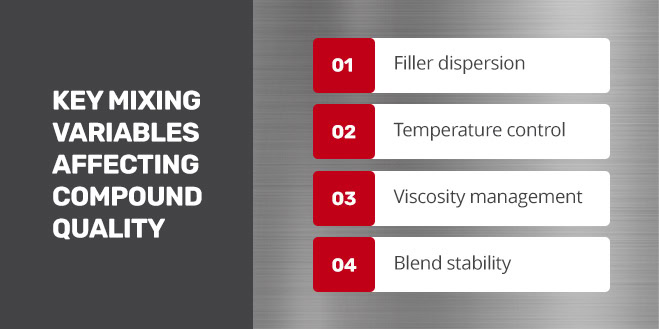
Four critical mixing challenges determine compound quality.
- Filler dispersion: Poor dispersion leads to variations in properties, resulting in inconsistent mechanical performance in finished products.
- Temperature control: Excessive temperature rise triggers premature vulcanization that destroys the compound before curing. Natural rubber compounds prove particularly sensitive to thermal damage during processing.
- Viscosity management: Natural rubber’s high molecular weight creates processing resistance that requires thorough mastication to incorporate fillers effectively. Different synthetic grades demand specific shear profiles calibrated to their unique flow characteristics.
- Blend stability: Achieving homogeneous blends requires precisely controlled shear and distributive mixing maintained throughout the entire process.
Processing equipment must simultaneously control all four variables to deliver consistent results, regardless of whether you’re working with natural rubber, synthetic compounds, or engineered blends.
Continuous vs. Batch Mixing for Rubber Compounding
Traditional batch mixing has dominated rubber processing for decades through a straightforward approach that included loading materials, running a timed cycle, discharging the compound, and resetting for the next batch. While this discrete processing method established industry standards, it creates inherent limitations that affect compound consistency and production efficiency, such as:
- Batch-to-batch variation from differences in loading, timing, and temperature
- Dead zones inside the mixing chamber where material never fully processed
- Limited temperature control, raising scorch risk for heat-sensitive compounds
- Higher energy consumption from repeated ramp-up and cooldown cycles
Continuous mixing addresses these fundamental limitations through precision process control. Raw materials enter the mixing chamber through precisely metered feeding systems that maintain controlled, steady rates. Compounds flow through the mixer in a constant stream under fixed processing conditions, with shear intensity, temperature, and residence time remaining stable throughout operation. This process eliminates the inherent variability introduced by batch cycling.
The advantages become particularly evident across different rubber types. Natural rubber processing benefits from the thermal precision that prevents scorch while ensuring complete mastication. Synthetic rubber compounds receive exactly calibrated shear profiles matched to each polymer’s specific flow requirements. Blended formulations achieve consistent homogenization in the stable, repeatable environment that multi-phase compounds require.
Continuous processing transforms mixing from a variable, batch-dependent operation into a controlled, predictable manufacturing process that delivers uniform results regardless of compound complexity.
Engineer the Ideal Solution for Your Application
Material selection sets the foundation, but precision mixing delivers the performance that determines your product’s success. Readco Kurimoto’s continuous processing technology eliminates batch-to-batch variations that undermine even the best material choices, delivering the exact mixing conditions your rubber compound requires every time.
We custom-engineer systems for demanding environments and decades of reliable operation. Every machine exceeds ASME and ASTM standards with a 316 stainless steel construction standard, and our engineers specify Hastelloy®, Alloy 20, tungsten carbide, and other specialized materials that withstand the most challenging conditions when your application demands it.
Readco Kurimoto’s Continuous Processor is suitable for mixing compounds with natural and/or synthetic rubbers. Readco Kurimoto’s Continuous Hybrid Reactor and SC Processor are capable of reacting specialty polymers. The Continuous Hybrid Reactor and SC Processor are able to control temperature and apply vacuum during material processing. The vacuum can significantly reduce contamination from the environment as well as remove VOC like moisture or solvents. Often moisture is an undesirable result of the reaction which must be removed from the final product. In other applications solvents or monomers are required during the reaction but must be removed from the final product to meet VOC reduction goals. Sometimes the solvent is re-used in future batches or contained for disposal via an environmentally responsible waste stream.
Partner with the acknowledged experts in continuous processing. Our engineering team will analyze your specific rubber compounding requirements and design a solution that delivers consistent, high-quality results without the variability of traditional batch methods. To explore how continuous processing can meet the specific demands of your rubber compounding application, contact our engineering team for a consultation.