

The most effective way to protect personnel is to contain these vapors and ultimately eliminate their interactions with the product. That’s where continuous processing comes in. Transitioning from open batch tanks to closed-loop continuous systems can help manufacturers improve safety while maintaining product consistency.
In this article, we’ll discuss how to eliminate risks inherent in open batch processing and achieve compliance through containment. You’ll learn how to safely process high-viscosity and volatile materials — without sacrificing speed.
Safety Challenges with Traditional Batch Methods
The traditional batch method can present many chemical mixing safety risks with its manual exposure points and open-loop flaws:
- Manual exposure points: In many facilities, operators must manually add bags of powder or pour liquids into a mixing tank. This moment of transfer is the riskiest point in the entire production line. Even with local exhaust ventilation, the operator is physically close to the hazard. Dust clouds from hazardous solids can form explosive atmospheres, while volatile organic compounds (VOCs) can escape into the breathing zone, putting personnel at risk.
- Inconsistent reaction control: Reaction control is another challenge. Large batch tanks often struggle with heat transfer. The material near the walls stays cool, while the material in the center can create a hot spot. In exothermic reactions, these hot spots can lead to runaway reactions. Due to the large volume of material in batch tanks, if a reaction were to accelerate out of control, there’s a higher risk of a major containment event — one involving thousands of pounds of chemical product.
- The open-loop flaw: The open-loop nature of batch processing makes maintenance much more difficult. Batch mixers often need to be cleaned between runs to prevent cross-contamination. This cleaning process usually requires operators to manually scrape the walls or use high-pressure washing to clean them, again exposing them to chemical residues. This cycle of constantly opening, filling, mixing, emptying, and cleaning can increase the likelihood of an incident.
Safety Advantages of Continuous Processing
With its fully enclosed system, continuous processing fundamentally changes the safety profile of chemical manufacturing. Here are the main safety benefits of continuous processors:
Closed-Loop Containment
A continuous processor works by feeding ingredients into the system at a steady monitored rate. From there, the ingredients are processed and discharged from the mix chamber. This containment engineering is the most effective way to adhere to the hierarchy of controls. It prioritizes hazard elimination instead of relying solely on personal protective equipment (PPE). From feed to discharge, the closed mix chamber limits vapor from escaping, helping protect personnel from the risk of exposure.
Small Process Inventory
One of the most critical safety features of a continuous processor is its small process inventory. While a batch tank could hold thousands of gallons of reactive material at once, a continuous processor work with just a few gallons at a time, and has a much shorter residence time, often less than a minute.
This means, at any given second, there are only a few pounds of material inside the mixer. If a power failure or reaction anomaly occurs, the risk is limited to that small amount of material. Reducing that active inventory can turn a potential safety event into a manageable maintenance task.
Minimizing Oxygen Interaction
Continuous processors can be easily blanketed with nitrogen or another inert gas. This can drastically reduce the risk of fire and explosions when working with flammable solvents. It makes maintaining an inert atmosphere more efficient and reliable, as the free volume inside the mixer is small. By displacing oxygen, the system keeps flammable vapors from finding an ignition source, safely processing solvents and combustible dusts that would be otherwise dangerous in an open tank.
Achieving Compliance with Continuous Processing
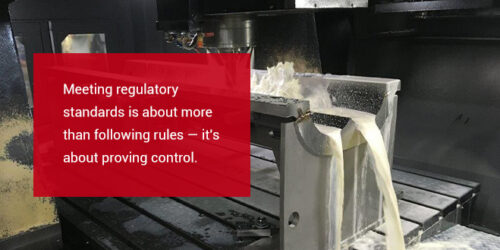
Meeting regulatory standards is about more than following rules — it’s about proving control. The National Fire Protection Association (NFPA) sets the standards for handling hazardous materials, and a continuous processor makes meeting compliance much easier.
NFPA 400 specifically addresses the maximum allowable quantity (MAQ) of hazardous materials allowed in a control area. Since continuous processors hold a small volume of material, they can help your facility stay well below the MAQ thresholds. This can make it easier to follow building code requirements while reducing the need for expensive fire suppression upgrades.
Documentation is also crucial to meet NFPA standards, and automated continuous systems make it easy by logging data for every second of production. They record temperature, pressure, motor load, and feed rates all in real time. If there’s an OSHA audit or quality control inquiry, you have a traceable digital trail to prove your process stayed within safe operating limits. This can be difficult to achieve with manual batch records.
Handling High Viscosity Materials
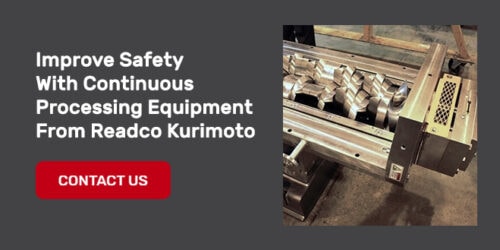
There’s a common misconception that continuous processors cannot handle thick or sticky materials. Yet, these systems are specifically engineered for high-viscosity applications that would otherwise stall a standard mixer. Readco Kurimoto’s equipment has a twin-shaft design, providing the right amount of torque to mix materials with the consistency of sealants or solid propellants.
The self-wiping geometry of the shafts is a critical safety feature for these materials. As the paddles intermesh, they continuously wipe the material from the partner shaft and barrel walls. This prevents product buildup, a common cause of overheating in sticky chemical mixes. By keeping the material moving and renewing the surface area, the processor ensures uniform heat transfer and prevents dangerous hot spots from forming.
Customizing Equipment for Chemical Compatibility
The safety of a chemical process largely depends on the materials of construction. Standard stainless steel is often insufficient for most corrosive or abrasive hazardous chemicals. If the equipment walls corrode, the containment is immediately breached. That’s why Readco Kurimoto engineers every machine with the specific chemical compatibility of the application in mind.
Advanced metallurgy options include Hastelloy®, Alloy 20 stainless steel, ceramics, and tungsten carbide. This ensures the physical integrity of the mixer remains intact throughout its years of service.
The integrity of the closed system also relies on the seals. Chemical-resistant seal materials can provide containment inside the barrel. These seals are designed to withstand the aggressiveness of the chemicals being processed, preventing leaks that could compromise operator safety.
Improve Safety with Continuous Processing Equipment from Readco Kurimoto
The era of using manual batch mixing for hazardous chemicals is coming to a close. The risks from open hatches, manual transfers, and large reaction volumes have made continuous processing the safer approach. It offers a solution where safety is engineered into the machine itself, not just added as a procedure.
Readco Kurimoto can help you transition to this safer, more efficient model. Built in the USA, our custom-engineered processors can help improve your safety in hazardous material handling. From reducing process inventory to helping you meet NFPA compliance, this advanced technology can help you keep up with modern safety demands. Our equipment also meets stringent ASME and ASTM standards.
Do not compromise on safety or efficiency. Contact us today to learn more about the continuous processor and how it can improve hazardous material handling.