

Understanding Material Flow in Mixing Equipment
Comments Off on Understanding Material Flow in Mixing EquipmentWhen mixing problems show up on the production floor, they often look like quality issues. One batch feels thicker than the last, ingredients take longer to incorporate, and the finished product varies just enough to cause concern.
In many cases, the real issue is the material flow. Material flow determines how ingredients move, how energy is transferred, and how consistent the final product becomes. When it is uneven, even well-designed mixers struggle to deliver reliable results.
This article will help you understand material flow in mixing equipment, enabling you to find the right mixer design for your applications.
Why Material Flow Matters More Than Mixing Speed
Mixing performance is often described in terms of motor size, blade speed, or horsepower. While these factors play a role, what ultimately determines whether a mixer performs well is how material actually moves inside the equipment.
When material flow is controlled, the following benefits follow:
- Even ingredient contact: Material that moves consistently allows ingredients to meet and combine evenly throughout the mixer.
- Uniform shear application: Controlled flow helps ensure mechanical energy is applied more evenly across the entire product.
- Stable temperature distribution: Continuous movement reduces the risk of hot spots by spreading heat more evenly.
- Repeatable processing conditions: Predictable flow paths ensure that each portion of material experiences similar mixing conditions.
How Viscosity Changes the Way Materials Behave
Low-viscosity liquids move easily and respond well to turbulence and circulation. Many traditional mixing principles are based on this type of behavior. As viscosity increases, however, materials can behave differently and place more demand on how a mixer controls movement.
Thick Materials Resist Movement
High-viscosity materials resist flow unless a sufficient force is applied to keep them in motion. Here’s how high-viscosity materials resist movement during mixing:
- Yield stress resistance: Many pastes and doughs remain stationary until enough force is applied to overcome their natural resistance to movement.
- Wall adhesion: Thick materials tend to cling to vessel walls, making it challenging to pull them back into active mixing zones.
- Flow stoppage: Without continuous forcing action, the material can come to a complete stop in certain areas of the mixer.
Why Traditional Batch Mixers Struggle With Flow Control
Batch mixers are widely used and well understood, but they weren’t designed with high-viscosity materials in mind. As materials become thicker and more resistant to movement, the way the mixers move material becomes increasingly unreliable. The result is uneven flow that is challenging to correct with speed or power alone.
Circulation Depends on Ideal Conditions
Once circulation weakens, large portions of the batch may stop moving altogether and display the following:
- Vortex-driven movement: Many batch mixers rely on a vortex to fold material over itself, but this becomes ineffective as the material thickens.
- Surface-focused circulation: Most movement occurs near the top of the batch, leaving lower regions with limited turnover.
- Viscosity sensitivity: As resistance increases, circulation slows, and large portions of material may stop moving.
Dead Zones Are Difficult to Avoid
Dead zones can be challenging to eliminate because of the following reasons:
- Wall buildup: Sticky materials tend to cling to vessel walls, reducing their exposure to active mixing.
- Baffle interference: Baffles create low-velocity regions where material movement may slow down or stop.
- Delayed release: Material trapped in dead zones can later break free, introducing batch inconsistency.
Gravity Works Against the Mixer
Gravity works against agitator-driven movement in dense materials in the following ways:
- Settling behavior: Heavier solids naturally migrate downward faster than they can be resuspended.
- Limited pumping reach: Agitators may lack the force needed to lift material from the bottom of the vessel.
- Vertical inconsistency: Flow conditions can vary significantly from top to bottom within the same batch.
What Controlled Material Flow Looks Like
When traditional circulation breaks down, improving results requires a different way of thinking about how material moves. Instead of encouraging material to flow, some mixing systems force movement in a controlled and repeatable way. This shift is especially important for materials that resist motion.
How Continuous Mixers Enforce Flow
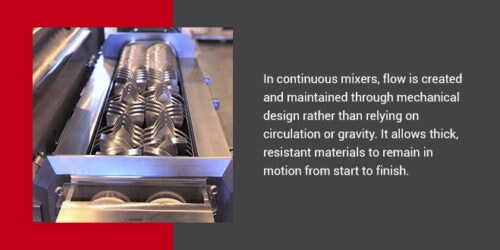
Controlled material flow doesn’t happen by chance. In continuous mixers, flow is created and maintained through mechanical design rather than relying on circulation or gravity. It allows thick, resistant materials to remain in motion from start to finish.
Twin-Shaft Movement Keeps Material Engaged
Twin-shaft movement creates stable operating conditions that are challenging to achieve in batch systems. Continuous mixers actively move material through the mixing chamber in the following ways:
- Twin-shaft advancement: Intermeshing shafts divide and recombine material while pushing it forward through the mixer.
- Defined flow path: Material follows a repeatable route instead of circulating randomly within a vessel.
- Steady forward progress: Once material enters the system, it continues moving toward discharge without looping back.
Self-Wiping Action Prevents Buildup
Self-wiping action is especially important when processing sticky or cohesive materials that tend to cling to surfaces. It plays a few key roles in continuous mixing:
- Wall cleaning: Mixing components continuously scrape material from the barrel walls.
- Shaft-to-shaft wiping: Opposing paddles prevent buildup between rotating components.
- Forced engagement: Material is physically displaced, leaving no opportunity to remain stationary.
Where Flow Control Makes the Biggest Difference
Material flow matters in every mixing process, but its impact becomes especially clear in applications where consistency, temperature control, or reaction timing are critical.
Adhesives and Sealants
In applications where controlled material flow directly improves mixing outcomes, the following examples stand out:
- Adhesives and sealants: Consistent flow prevents stagnant areas that can lead to premature curing or hardening in the mixer.
- High-fill formulations: Forced movement keeps solids evenly distributed, preventing settling or separation.
- Cohesive pastes: Continuous motion prevents material from compacting or sticking to internal surfaces.
Food Pastes and Doughs
Food products place additional demands on material flow because of their sensitivity to temperature and texture. In food processing applications where flow consistency is important, controlled movement supports the following outcomes:
- Even heat distribution: Continuous movement reduces the risk of localized overheating.
- Consistent texture: Uniform shear supports a stable structure and mouthfeel.
- Process stability: Long production runs remain easier to manage without frequent adjustment.
Chemical Processing
Chemical processes require precise control over the time the material remains in the mixer. In chemical processing applications that demand tight control, consistent material flow enables the following advantages:
- Consistent residence time: Every portion of material spends the same amount of time in the mixing zone.
- Immediate reaction control: Reaction initiated quickly due to intense mixing. Often batch mixing has a slower reaction time.
- Reduced process variability: Predictable flow helps stabilize reaction outcomes.
Turning Mixing Into a Predictable Process
When material flow is intentionally controlled, the process becomes more stable and easier to manage. For engineers, this removes much of the guesswork that often accompanies batch mixing.
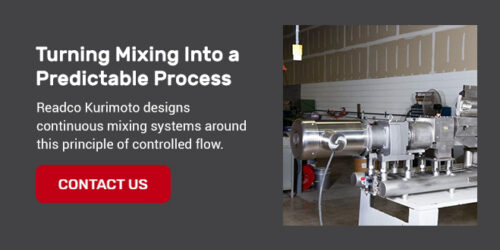
Readco Kurimoto designs continuous mixing systems around this principle of controlled flow. By focusing on movement through mechanical design rather than relying on circulation, our solutions transform mixing from an adjustment-heavy operation into a repeatable process built on sound engineering fundamentals. Contact Readco Kurimoto today to explore our advanced mixing technology.
How to Prevent Damage and Maintain Particle Integrity When Mixing
Comments Off on How to Prevent Damage and Maintain Particle Integrity When MixingFor a wide variety of products, including powders, granules, active ingredients, and heat-sensitive materials, maintaining particle integrity can mean the difference between a product that functions as intended and one that doesn’t meet quality standards.
Readco Kurimoto’s continuous mixing technology was developed to provide efficient and consistent mixing while protecting the structure of each particle that passes through the machine.
Reasons Particles Degrade During Mixing
There are predictable reasons why particles degrade during mixing.
1. Uncontrolled Shear
Batch mixers typically use high-speed blades or paddles that generate significant shear forces to break particles before the blending is complete.
2. Excessive Exposure Time
Batch processes are limited only by the time required to achieve a uniform blend. Ingredients remain in a vessel under constant motion until the desired blending is achieved. The longer ingredients remain in the vessel, the greater the amount of heat, friction, and mechanical stress that develops.
3. Nonuniform Motion
Inside a large batch tank, ingredients do not always move uniformly. Some areas experience intense mixing forces while others may be subject to very little. Inconsistent motion is common and can lead to the fracturing of delicate particles and nonuniform results throughout multiple batches.
Each of the above limitations is due to the fact that very few aspects of batch mixing are controllable. Since quality depends on particle integrity, “uncontrollable” becomes a significant limitation.
Why It Is Important to Preserve Particles and Ways to Save Them
When particles break down, the final product may show different characteristics. For example, pharmaceutical dosage accuracy can be affected by broken particles, food texture can change, inclusions can break apart due to physical forces and chemical reactions, and flow can be impacted by broken particles in specialty chemical products. Even a minimal amount of particle breakdown will contribute to poor product quality.
Therefore, the equipment used to process the materials must also preserve the materials’ integrity. Readco processors meet and exceed both ASME and ASTM standards and are available in various alloys, including 316 stainless steel, Hastelloy, and Alloy 20 for difficult applications. Close manufacturing tolerances ensure that no additional variability is created by the processor, and little to no downtime occurs.
If you want to prevent damage and maintain particle integrity when mixing, the core principles are straightforward:
- Apply only the shear required by the application. Gentle mixing prevents unnecessary breakage.
- Keep mixing time as short as possible. The longer the material is stressed, the more likely it is to be damaged. Continuous mixing naturally limits exposure.
- Choose a screw design that suits the material. Engineers can select elements that move and mix particles in a controlled way without crushing them.
- Use the right metallurgy. The correct alloy reduces friction, supports cleanability, and helps protect particle structure.
These steps make it easier to maintain product quality and reduce the risk of particle-related failures.
Continuous Mixing Eliminates the Most Common Sources of Particle Damage
Continuous mixing eliminates the uncertainty of a batch tank by creating a controlled and engineered environment for mixing. Unlike traditional batch mixing, where a full vessel of product is agitated for a relatively long time, the Readco Kurimoto Continuous Processor continuously moves material through a predetermined path at a steady pace. Because the movement of the material is predictable, the shear forces applied during mixing can be adjusted to match the properties of the material being mixed, rather than exceeding them. Working with smaller amounts of material in a continuous flow allows the mixing process to occur quickly and efficiently.
Below are some examples of how this translates into actual applications.
Shear forces are purposefully generated, not by accident
Using a twin-shaft screw design, engineers can specify the exact mixing action that is necessary for the particular formulation being processed. Elements of the screws can be positioned to provide folding, conveying, dispersion, low-shear action, or high shear if necessary.
Material spends less time under mechanical stress
One of the greatest benefits of continuous processing is the short residence time of the material in the mixing chamber. Material is subjected to the minimum amount of time required to perform the mixing function. In contrast, in batch processing, ingredients are subjected to potentially hours of mechanical stress in the form of mixing action, abrasion against the vessel walls, and contact with other ingredients to ensure that the entire batch of material is mixed.
All particles are treated equally
Continuous mixing eliminates the randomness associated with batch processing. Each ingredient passes through the mixing chamber in a predetermined manner, eliminating all potential for dead zones, stagnation, and impact-induced damage.

Explore a Mixing Solution Built for Your Material
If maintaining particle integrity is important for your process, choose Readco Kurimoto. Our engineers will analyze your formula to develop a customized system that produces consistent results with minimal disruption to your particles.
Contact us today, and we can work together to develop the best possible solution for you.